

Finding purpose helps recovery stick. Group addiction therapy builds skills and gives you peers who care. Life skills and goal-setting turn those skills into daily action. You learn to set clear goals, track progress, and handle stress in small, repeatable steps. Research shows that goal setting and monitoring improve engagement and outcomes when used in conjunction with treatment. It also shows that group therapy reduces isolation and helps you practice new skills with feedback. You can blend group work with individual therapy, mindfulness, and simple home routines. That mix builds confidence and protects your time and energy. This guide shows you how to write goals you can keep, how to practice life skills every day, and how to plan for safety topics like benzodiazepine withdrawal and opioid detox under medical care. Every section includes plain steps and links to official sources or peer-reviewed studies you can share with loved ones or a clinician.
Want a simple plan you can start today that fits real life? Keep reading.
Why purpose and life skills matter in group therapy for addiction
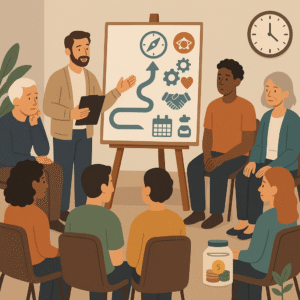
Purpose gives you a reason to keep going when days feel hard. Life skills turn that purpose into actions you can repeat. In group therapy, you see others practice the same skills. You learn from wins and setbacks in a safe room. SAMHSA explains that groups reduce isolation, teach skills, and help people rehearse new habits together.
Life skills are simple on purpose. Think of them as micro-moves. You plan your morning, say what you need calmly, solve a problem with three steps, and track one tiny win. Over time, small moves change larger patterns. NIDA notes that behavioral therapies work best when they build coping skills for high-risk moments, and when they are part of a full care plan that can include medicines and peer support.
- Purpose: know your “why” in one sentence
- Skills: choose tools you can do in five minutes or less
- Practice: use your group to test and refine skills
- Support: add one peer and one clinician to your plan
- Review: check in weekly and adjust your goals
The science behind goal-setting and peer support
Goal setting and monitoring help people and clinicians agree on a plan and track progress together. A 2021 review found that structured goals and regular check-ins improve engagement and outcomes in alcohol and other drug treatment when they are collaborative and specific.
Peer support adds energy to those goals. In a good group, you get feedback, coaching, and a sense that you are not alone. SAMHSA’s group therapy manual describes how skills groups, psychoeducation groups, and cognitive behavioral groups all use practice and peer modeling to lock in new habits.
- Write goals with your clinician and use a shared checklist
- Share your goals with your group or a trusted peer
- Review goals weekly and trim what you do not need
- Celebrate small behaviors, not just big outcomes
- Keep your plan on one page so you can carry it
Goal frameworks that work: SMART plus tiny “if-then” plans
SMART goals are Specific, Measurable, Achievable, Relevant, and Time-bound. They help you say exactly what you will do and when. This structure supports mental health and health behavior change when goals are realistic and tracked often.
Add one more tool called an “if-then” plan. It is a simple sentence you can use during stress. Example: “If I feel a craving at a cookout, then I will text my support and take a five-minute walk.” Linking a trigger to an action helps your brain choose faster in the moment. It supports relapse prevention skills you practice in the group. Pair this with a daily check box so you see proof of progress each day.
- Write one SMART goal for this week
- Add one if-then plan for a common trigger
- Put both on a card or your phone lock screen
- Track daily with a single check mark
- Review every Friday and adjust
How to blend group therapy, individual therapy, and peer support
Think of your week as a loop. Group teaches a skill. You practice at home. Individual therapy helps you personalize the skill and process feelings. Peer support keeps you steady between sessions. SAMHSA’s materials describe how coordinated care and clear roles improve progress across levels of care.
Here is a simple rhythm. Attend one group. Use the skill at home for ten minutes a day. Meet your individual therapist to refine the plan. Send a quick update to one peer midweek. The goal is not to do more. The goal is to repeat the right few things often so they stick. NIDA emphasizes combining therapies and supports to meet medical, psychological, and social needs together for the best results.
- Group: practice a skill with peers
- Home: repeat it daily in short blocks
- Individual: tune the plan to your story
- Peer: share one win and one challenge
- Weekly: keep what works, drop what does not
Life skills you will use every day
Communication skills help you say what you need without a fight. Try “I feel” and “I need” statements. Add a pause word for tense talks. Practice in group and at home so your body learns the moves. Skills like these are a core piece of cognitive behavioral group work and social skills training in substance use care.
Problem-solving skills keep you from feeling stuck. Name the problem, list options, pick one small step, and test it. Come back to group with what you learned. Over time, this builds mastery and confidence. That sense of mastery supports recovery and lowers risk during high-stress moments.
- Communication: one feeling, one need, one plan
- Problem solving: name, list, choose, test, review
- Time blocks: ten minutes for skills, ten for planning
- Self-care basics: sleep, food, movement, sunlight
- Weekly review: what to keep, what to change
Mindfulness as a bridge between goals and action
Mindfulness means paying attention on purpose with kindness. It can create a pause between urge and action. That pause lets you use your goal plan instead of old habits. A large trial found that mindfulness-based relapse prevention and cognitive relapse prevention both lowered relapse risk compared with usual aftercare at six months, with mixed patterns over time. Reviews suggest mindfulness can help with craving and stress when used with standard care.Keep practice short and steady. Try three minutes of breathing before dinner. Try a five-senses check during loud or busy times. Use a short walk after a hard talk. Brief drills are easier to keep, and they link neatly to group skills like urge surfing and thought checking.
- Three-minute breath: in 4, out 4, ten times
- Five senses: see, hear, feel, smell, taste
- One long exhale before you speak
- Ten-minute walk to reset after stress
- One win written down each night
Relapse prevention with goals you can measure
Relapse prevention is a set of learned moves. You plan for triggers, you use coping steps, and you repair fast if a slip happens. Classic work and later reviews show that structured relapse prevention reduces heavy-use days and supports longer time to relapse when practiced and reinforced over time.
Make your plan one page. Add three top triggers, two if-then moves, one peer-to-text, and one reward for practice. Schedule a five-minute review each week. Use your group to role-play hard moments and refine the moves. Keep the plan visible at home so it is easy to follow during stress. Pair the plan with mindfulness so you can pause and choose the next right action.
- Triggers: people, places, things, and moods
- If-then: link a cue to a healthy action
- Supports: one clinician and one peer
- Rewards: small and fast, like a walk or a favorite meal
- Review: same day and time each week
Safety corner: benzodiazepine withdrawal and opioid detox
Benzodiazepine withdrawal must be guided by a clinician. Do not stop all at once. The 2025 ASAM joint guideline offers taper options and patient guidance for safe dose changes over time. There is also a brief patient handout that you can review with your prescriber. The FDA requires boxed warnings on all benzodiazepines about risks of misuse, dependence, and withdrawal. This is why medical care comes first for any taper plan.
Opioid detox is also medical. ASAM’s National Practice Guideline recommends medications for opioid use disorder, such as buprenorphine or methadone, for withdrawal management and ongoing care, not abrupt stopping. This reduces relapse and overdose risk. Work with a trained prescriber to choose a plan you can keep. SAMHSA’s summary page also points clinicians and patients to the OUD guideline if you need a quick overview.
- Never start or stop benzodiazepines or opioids without medical advice
- Ask about a slow benzo taper with a clear schedule
- Ask about buprenorphine or methadone for OUD care
- Tell your clinician about all medicines and supplements
- Keep naloxone where adults can reach it fast if opioids are present
A simple weekly loop you can copy
You need a plan that fits a busy life. Keep it short and repeatable. Use the same steps each week so your brain can run them on autopilot.
Start with a single page. Put your group time, one SMART goal, one if-then plan, and your daily ten-minute practice block on it. Add your peer’s name and your therapist’s name. Add a small Friday reward for doing your practices. Keep this page on your phone and your fridge. Review it on Sunday night before the week starts. This keeps your plan visible and easy to follow. It also makes it simple to show your group or clinician where you are stuck so they can help you adjust.
- Sunday: set one goal and one if-then plan
- Monday to Thursday: practice ten minutes a day
- Friday: review wins and give yourself a small reward
- Saturday: one sober activity with a friend or family
- Keep the same cycle each week and adjust as needed.
Red flags and quick help
Call emergency services for severe chest pain, trouble breathing, seizures, or overdose signs. If opioids are present in your home, carry naloxone and learn how to use it. CDC offers clear steps for lay responders. SAMHSA provides a 24-7 helpline for treatment referrals and support in English and Spanish at 1-800-662-HELP.
- Store naloxone where adults can reach it
- Keep a paper copy of your safety plan
- List your clinician, pharmacy, and a backup contact
- Review safety steps once a month
- Ask for help early, not late
Frequently asked questions
Is group therapy enough by itself?
Group therapy helps many people. It works best when combined with other supports like individual therapy, peer support, and, when needed, medicines. SAMHSA’s manual shows how group formats deliver skills and structure. NIDA highlights combining therapies for medical, mental, and social needs as a best practice.
- Use group for skills and practice
- Add individual therapy for personal needs
- Use peer support for daily check-ins
- Ask about medications when appropriate
- Keep one page that ties it all together
How do I write goals I can keep
Use one small SMART goal per week and one if-then plan for a common trigger. Track daily with a single check box. Review every Friday and reward practice. Research shows that clear, collaborative goals with ongoing monitoring help engagement and progress in treatment.
- Keep goals small and specific
- Make them visible on your phone or fridge
- Please share them with a peer or clinician
- Drop goals that do not serve you
- Celebrate effort each week
What should I know about benzodiazepine withdrawal?
Never stop benzos on your own. Work with a clinician on a slow taper. Use the patient guide and the full guideline if you want details. The FDA boxed warning explains risks and why supervision is important.
- Tell your prescriber all medicines you take
- Ask for a written taper plan
- Avoid alcohol during a taper
- Use group and individual therapy to manage stress
- Call for help if symptoms worsen
What should I know about opioid detox?
Opioid detox is medical. Ask about buprenorphine or methadone during withdrawal and for ongoing care to reduce relapse and overdose risk. Follow ASAM’s guideline and use SAMHSA’s quick summary if you want a short overview.
- Do not stop on your own
- Ask about medicines for OUD care
- Keep naloxone on hand if opioids are present
- Plan extra support during the first weeks
- Review your plan weekly with your team
Bringing it all together
Purpose gives you direction. Life skills and goal-setting make purpose real. Group therapy helps you practice. Individual therapy helps you personalize. Peer support keeps you steady. Mindfulness links goal and action. For safety, work with clinicians on any benzodiazepine taper or opioid detox. The research and national guides point to a clear theme: choose a few simple steps, practice them often, and adjust them with support as your life changes. That is how small wins add up over time.
- Pick one weekly goal and one if-then plan
- Practice ten minutes a day
- Share progress with your group and a peer
- Keep safety first for medical topics
- Repeat the loop and celebrate small wins
A gentle next step
If you want a calm, structured path that blends group therapy, individual therapy, peer support, and practical life skills, explore Capital Recovery Health. You can learn about flexible programs for adults and how a warm, supportive setting helps people practice skills and set goals they can achieve and maintain. Ask about admissions, schedules, and how to build a first-week plan that fits your life. Take one small step today to move from ideas to action. If you want help today, call 603-207-4814.