

Drug rehab offers evidence-based care that can be delivered at various levels. While each journey is unique, there are similarities that apply to all clients. This article will review what to expect.
Table of Contents
- Levels of Care in Substance Abuse Treatment
- Therapies Used to Treat Alcohol or Drug Addiction
- Holistic Therapy Treatment For Substance Use Disorders
- How Long Does Recovery Last?
- What to Bring and What to Expect on Day One
- Capital Recovery Supports Your Wellness Journey
- FAQs
Key Takeaways
- People may put off drug addiction treatment because they are unsure of what to expect. A clear understanding of the process can boost adherence.
- The therapeutic process typically involves various levels of care, including partial care, intensive outpatient services, and traditional outpatient treatment. These levels can be primary care or part of a step-down approach.
- Most inpatient or residential programs follow a rigorous daily schedule that balances clinical therapy, educational workshops, and wellness activities, focusing entirely on recovery. Holistic and evidence-based approaches are integrated to support overall well-being.
- Starting a new program makes some people nervous, but most clinics provide a supportive environment with therapists and group members who support one another’s well-being.
Introduction
SAMHSA statistics published by the National Association of Counties (NAC) reveal that only 15.6% of the 48.5 million people needing SUD recovery actually enter a substance abuse treatment program. Barriers include cost and stigma, but for some, it’s fear of the unexpected. People may not know how recovery will change them or what to expect during treatment.
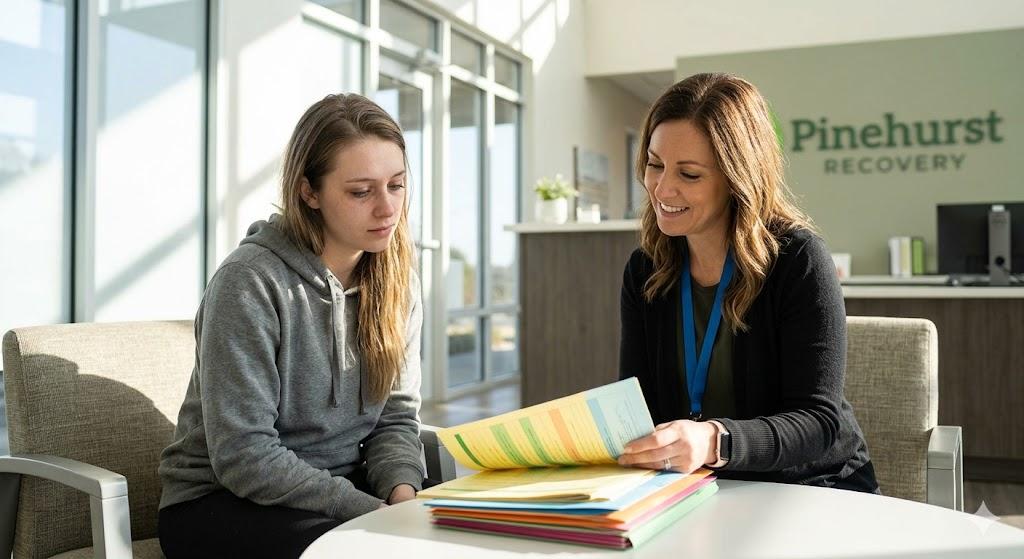
This article tells you exactly what to expect, preparing you for what’s ahead- and generally, it’s all good.
Levels of Care in Substance Abuse Treatment
Most drug addiction treatment centers offer various levels of care. Each can serve as a primary treatment or be integrated into a step-down approach.
Capital Recovery provides treatment in an outpatient setting, offering the following services:
- Partial Care: Partial hospitalization programs (PHP) offer a structured treatment environment similar to inpatient care but do not require overnight stays and typically involve 20 or more hours of treatment per week. Clients engage in individual and group therapy sessions, learning coping skills to manage their emotions in a healthy way.
- Intensive Outpatient Program: Intensive outpatient programs (IOPs) require less time commitment than PHPs, usually involving about 10 hours of treatment per week, allowing individuals to balance recovery with daily responsibilities. Clients typically attend shorter therapy sessions 3-5 days a week.
- Traditional Outpatient Treatment: At this level, clients continue seeing a therapist once or twice a week or on an as-needed basis.
- Aftercare Planning: After the program is completed, addiction treatment centers continue to provide care and ongoing support resources to ensure clients remain engaged, inspired, and committed to recovery.
Therapies Used to Treat Alcohol or Drug Addiction
Various evidence-based treatments may be integrated into addiction care as part of individual behavioral therapy. Common methodologies that focus on substance abuse and mental health include:
- Cognitive Behavioral Therapy (CBT): Cognitive Behavioral Therapy (CBT) is one of the most effective methods used in addiction treatment, focusing on how emotions impact thoughts and behaviors. Shown to reduce relapse rates by 60%, it encourages clients to identify and address negative thought patterns and learn coping skills to deal with their emotions in a healthy way.
- Dialectical Behavior Therapy (DBT): Takes a more mindful approach to emotional regulation through distress tolerance.
- Motivational Interviewing (MI): Encourages clients to reflect on their values to address ambiguity in the recovery process.
- Trauma-Informed Care: Exposure therapy is often used, allowing clients to experience trauma in a safe space so it doesn’t feel as overwhelming.
- Family Therapy: Family support is often a crucial element of treatment, as addiction impacts the entire family and can lead to destructive behaviors such as codependency and enabling.
Holistic Therapy Treatment For Substance Use Disorders
Various holistic therapies can be used as complementary therapies to evidence-based approaches. While not traditional, they have been shown to yield beneficial results, including stress relief, improved relationships, and better overall health. The Capital Recovery program often integrates the following practices alongside traditionally proven methods.
- Yoga: May reduce stress, cravings, anxiety, and depression.
- Meditation and Mindfulness: Teaches clients to observe cravings and emotions without automatically reacting to them.
- Art Therapy: Promotes self-expression and self-confidence.
- Equine Therapy: Horses are sensitive to human approaches and can help relieve feelings of anxiety and depression.
- Recreational Therapy: Holistic and recreational activities can include art therapy, music therapy, nature walks, and fitness workouts to promote overall wellness. Hiking and other group activities help people rediscover enjoyment, rebuild routines, and regulate their moods.
How Long Does Recovery Last?
The duration of recovery varies depending on the severity of addiction and accompanying mental health conditions. Here are some ranges that typically apply:
- Partial Care: 2-6 weeks
- Intensive Outpatient Programs: 8-12 weeks
- Traditional Outpatient Care: Several months to a year
What to Bring and What to Expect on Day One

While outpatient rehab doesn’t require packing all daily essentials, you should bring:
- Insurance and Documentation: These may be necessary for the intake process.
- Medications: Bring along any medications you may need to take during the day. Ensure they are properly labeled to indicate they are legally prescribed and belong to you.
- Comfort Items: Dress comfortably and bring along a bottle of water, snacks, a sweater or light jacket, and a journal if you so desire.
- Restricted Items: Learn about what not to bring. For example, electronics may be limited in rehab to help residents focus entirely on their recovery and interact with peers.
Day one will be mostly about orientation and getting to know each other. You’ll meet your therapist and the other group members and learn about your treatment plan. You may also start some meetings, typically focusing on relapse prevention.
The first day can be difficult, but the right drug and alcohol rehab facility will offer a safe environment, a home-like setting, and supportive members and therapists. A community atmosphere in rehab fosters camaraderie, where peer support significantly reduces feelings of isolation and shame.
Capital Recovery Supports Your Wellness Journey
Capital Recovery of Boscawen, New Hampshire, is a premier option for outpatient care. We offer various treatment options, individualized to the client’s needs. Our PHP-specific approach integrates evidence-based and holistic therapies, enabling individuals to balance treatment with daily responsibilities to achieve lasting recovery.
Contact us to learn more about how we help clients get sober and stay sober.
FAQs
Is PHP covered by insurance?
Yes, in most cases, you can use insurance coverage for drug or alcohol addiction treatment. The Mental Health Parity and Addiction Equity Act ensures that services are covered, comparable to other types of medical care. However, coverage can vary by provider.
What if I have a co-occurring disorder like anxiety and depression?
Mental health issues often exist alongside drug abuse as people use illicit substances to self-medicate. As a result, many treatment centers take a dual diagnosis approach, treating addiction and its underlying causes. Symptoms can be addressed in PHP, in both group therapy and individual sessions.
How do I know if PHP is the right level of care for me?
PHP is a good fit for individuals with a strong support system who don’t need 24/7 supervision but require more structure and support than standard outpatient programs. It’s also suited to individuals stepping down from inpatient rehab. A medical professional can help you determine which level is best suited to your needs.
Sources
- Substance Abuse and Mental Health Services Administration (SAMHSA). “Key Substance Use and Mental Health Indicators in the United States: Results from the 2023 National Survey on Drug Use and Health.” https://www.samhsa.gov/data/data-we-collect/nsduh-national-survey-drug-use-and-health/national-releases/2023
- National Institute on Drug Abuse (NIDA). “Principles of Drug Addiction Treatment: A Research-Based Guide (Third Edition).” https://nida.nih.gov/sites/default/files/podat-3rdEd-508.pdf
- National Institute on Drug Abuse (NIDA). “Treatment and Recovery.” https://nida.nih.gov/publications/drugs-brains-behavior-science-addiction/treatment-recovery
- National Institute on Drug Abuse (NIDA). “Stigma and Discrimination.” https://nida.nih.gov/research-topics/stigma-discrimination
- Substance Abuse and Mental Health Services Administration (SAMHSA). “Receipt of Services for Substance Use and Mental Health Issues among Adults: Results from the 2016 National Survey on Drug Use and Health.” https://www.samhsa.gov/data/sites/default/files/NSDUH-DR-FFR2-2016/NSDUH-DR-FFR2-2016.htm
- U.S. Department of Health and Human Services, Office of the Assistant Secretary for Planning and Evaluation. “Best Practices and Barriers to Engaging People with Substance Use Disorders in Treatment.” https://aspe.hhs.gov/reports/best-practices-barriers-engaging-people-substance-use-disorders-treatment-0
- Boness, C.L., et al. “An Evaluation of Cognitive Behavioral Therapy for Substance Use Disorder: A Systematic Review and Application of the Society of Clinical Psychology Criteria for Empirically Supported Treatments.” PMC. https://pmc.ncbi.nlm.nih.gov/articles/PMC10572095/
- Recovery Research Institute. “‘We Do Recover’: More Evidence That Tens of Millions of Adults in the United States Have Recovered from a Substance Use Problem.” https://www.recoveryanswers.org/research-post/millions-americans-in-united-states-report-recovery-from-substance-use-problem/
- Hendriks, V., et al. “Understanding the Process of Drug Addiction Recovery Through First-Hand Experiences: A Qualitative Study in the Netherlands Using Lifeline Interviews.” PMC. https://www.ncbi.nlm.nih.gov/pmc/articles/PMC10426251/
- Vo, Q.T., et al. “Trends in Treatment Need and Receipt for Substance Use Disorders in the US.” PMC. https://www.ncbi.nlm.nih.gov/pmc/articles/PMC11704973/
- Witkiewitz, K., et al. “Yoga: A Holistic Approach to Addiction Treatment and Recovery.” OBM Integrative and Complementary Medicine. https://www.lidsen.com/journals/icm/icm-06-04-047
- King, J., et al. “Art Therapy’s Engagement of Brain Networks for Enduring Recovery from Addiction.” PMC. https://pmc.ncbi.nlm.nih.gov/articles/PMC11743619/
- Penn State Brandywine. “Yoga May Enhance Traditional Recovery Programs, Researchers Find.” Medical Xpress. https://medicalxpress.com/news/2026-04-yoga-traditional-recovery.html
- American Society of Addiction Medicine (ASAM). “The ASAM Criteria.” https://www.asam.org/asam-criteria
- National Institute on Drug Abuse (NIDA). “Treatment Approaches for Drug Addiction.” https://www.cde.state.co.us/healthandwellness/mhrb/drugaddictiontreatment